Friday, 16 February 2024

 John Cooke

                Engraver and Publisher: 1765 - 1845                       

JOHN COOKE – of London and Plymouth


THIRD EDITION

Newly Revised 2024 


INTRODUCTION

INTRODUCTION to The Third Edition 2024

 I am an avid collector of Devon guidebooks and soon became aware that a certain John Cooke had either engraved, or engraved and published, plans of the Plymouth area or of its breakwater which expanded in to an article about Plymouth Breakwater.[1] Over the years I managed to acquire a number of maps and plans depicting this monumental enterprise and Cooke´s name appeared several times. The name John Cooke is certainly not rare. However, there appeared to be two or even three engravers of that name around this time, with two operating from London, the other from Stonehouse, Plymouth, not counting the other Cookes active in the book and printing trades at the turn of the nineteenth century. According to Tooley´s Dictionary of Mapmakers (the most reliable source at that time) there seemed to be a father and son team of John and Charles Cooke[2] in London as well as a possible second John in London and yet another John in Plymouth.

In the course of my research, I had the good fortune to come into contact with Laurence Worms. He is one of the leading experts on British engravers and in the meantime had compiled a list of John Cooke´s work and, like me, was convinced that the entry in Tooley was incorrect. The first edition of this present work was a result of the extra input he was able to provide. We were able to prove beyond doubt that one of the John Cookes of London was also the John Cooke who was responsible for the Plymouth output.[3] However, we were not able to piece much of his family life together.

In spring 2021 I was very fortunate that Dr Shirley Atkinson contacted me about John Cooke shortly after I posted his work on the internet.[4]  She is directly descended from John Cooke through his second son Edward. Dr Atkinson was able to furnish me with copies of many of the documents that had been lacking when I wrote the first edition. Since our first contact she has provided me with more information and the second edition was completely revised to include the new facts – and also less speculation – about John’s life.

In the course of including Dr Atkinson’s material, I took the opportunity to add new information which had come to my attention since the first and second editions; this included one new map (24A) as well as many more illustrations which have come to light. The interested reader will discover more about the projects which John Cooke worked on both before moving to Plymouth, and his career while residing in Stonehouse, now in Plymouth, but in 1815 a bustling community perched between Plymouth in the east and the important dockyards to the west.

The internet is becoming increasingly important for researchers, as more and more works are digitalised and made available to the public. Online retailers and antiquarian bookshops as well as auction houses are posting more and more information and images of works in their possession and the patient researcher can discover hitherto unknown works. Such is the case with this present edition. The world wide web can be frustrating and surprising: entering the same search requirements five times can provide five different results; and some lead to sites one had used but which now reveal something totally new or suggest a new lead to follow up further. In only twelve months, due to a combination of diligence, fluke and serendipity I have been able to uncover a wealth of non-cartographic material executed by John Cooke. These range from an anti-Jacobin caricature produced in 1799 for a London publisher, an early aborted project for an atlas to plates of fossils executed for a local Stonehouse author.

Although only one new chart was discovered in this period, the Mercator’s Chart from England to Greenland (1A), a more detailed look at David Steel´s Elements of Rigging reveals that John Cooke produced nearly 50 of the plates at an early stage of his career. Nevertheless, the new material added to that which we already know about cannot be all he produced in his lifetime: there is more to be discovered out there.  

Any errors in transcription or interpretation are all mine and where I have taken the liberty to speculate, I hope I have clearly indicated this. Acknowledgements for contributions and illustrations are included and I am indebted to all those who furnished me with details, however trivial.

 Kit Batten

 Third Edition

 Stuttgart, February 2024


CONTENTS

IMPORTANT: To go directly to the individual maps, begin by opening Part IV. Short List. This has a list of all 36 cartographic works with links to each map listed in chronological order.

Click the link (blue) to go directly to the following chapter. 

Part One - The Life of John Cooke

Confusion                                                                                          

  John Cooke - London                                                          

John Cooke (1765-1791)

John Cooke of Hendon and Mill Hill (1792-1796)

John Cooke of Howland Street (c.1799-1805)

The Ladies Circular Atlas and “Mr Barrow”

The Rev. Thomas Smith and The Universal Atlas

John Cooke at the Admiralty (1802-1805)

Between the Admiralty and Plymouth (1805-1812)

Synopsis of Geography 

 II. John Cooke - Plymouth      

Stonehouse (1813-1845)

Napoleon and Cooke´s first Plymouth engravings

The Copper-Plate Engraving, and Printing Office (1815-21)

John Cooke of Union Street, Stonehouse (1823-1845)     

 III. John Cooke - Summary      

                    A Summary of John Cooke´s life

Part Two - Cartographic Works

IV. Short list of Cartographic Works by John Cooke    

                    A list of all John Cooke´s cartographic output

 V. List of Addresses used by John Cooke      

                    Addresses associated with John Cooke

 VI. List of Apprentices taken in by John Cooke    

                    Apprentices taken on by John Cooke

Part Three - Cartobibliography

 VII. The Cartographic Works of John Cooke      

                    Maps 1 - 36 in chronological order

Part Four - Acknowledgements and Sources of Material

 VIII. Acknowledgements             

                    Thanks to those who have made this possible    

 IX. Sources for illustrations    

                    Sources of those images reproduced on this website


Monograph: John Cooke - Engraver and Publisher - 1765 London -1845 Plymouth. All rights reserved. Copyright lodged with British Library and other major libraries.

Notes on using my Blog. 

1. Maps are numbered in sequence as used in my monograph lodged with DevA, WDRO and BL and other major libraries. See Chapters IV and VII.

Map 24A was originally thought to be by or for Byers and was added later when it transpired it was a Cooke plan.

2.  Ignore the dating of individual blog page publication. To run sequentially I had to "fiddle" the published date.

3. If you are aware of further works by Cooke, please let me have details. If you notice any mistakes (there are probably many) also contact me at KitTheMap@aol.com.

Kit Batten

January 2010/Revised 2012/2020

Blog posted October 2020 (First Edition)

Blog updated to Second Edition June 2021 

Blog updated to Third Edition from February 2024 


[1] See Kit Batten: Plymouth Breakwater; in MapForum, Issue 9 Spring 2006, pages 62-68. Now updated and available on-line at https://plymouthbreakwater.blogspot.com/.

[2] See Tooley´s Dictionary of Mapmakers Vol. I; Map Collector Publications;1979; pages 295 and 297. 

[3] Kit Batten: Who Were John Cooke? – Finally getting it right?: IMCOS Journal No. 126; Autumn 2011.

[4] This Third Edition will replace it at https://john-cooke-cartographer.blogspot.com/.


                                                      Imprint:

John Cooke – Engraver and Publisher

1765 London – 1845 Plymouth

Third Edition


This Edition published privately in 2024.


Copyright © 2024 Kit Batten.

A copy of this book has been lodged with the British Library.

Reference copies are available at Devon Archives and Heritage Centre, Exeter

And at Plymouth Central Library.


This work is dedicated to the late

Francis Bennett.

Always a friend and ever generous with advice

and information he also sold me copies of

works by John Cooke.

Without this input I would probably never have begun this monograph.


An updated version of this monograph can be found on-line at:

https://john-cooke-cartographer.blogspot.com/

Please note that the same copyright rules apply to the on-line version,

i.e., all images remain the property of the legal owner and cannot be used in any way without conforming to the standard rules and regulations concerning attribution of the same copyright.

For a full list of Kit Batten´s articles listed on-line go to:

https://welcome-to-kits-blog.blogspot.com/2021/12/blog-post.html

 The moral right of Kit Batten to be identified as the author of this work has been asserted by him in accordance with the Copyright, Designs and Patents Act 1988.

All rights reserved. No part of this publication may be reproduced, stored in a retrieval system, or transmitted in any form or by any means without the prior permission of the copyright holder.

Any illustrations used in this, on-line version (https://john-cooke-cartographer.blogspot.com), may not be reproduced without the explicit consent of the copyright holder. A list of sources for all illustrations will be found at the back of this work.


London


Confusion

Towards the end of the 18th century and the dawn of the 19th there were literally thousands engaged in the printing and allied trades in London. Many printers were also publishers, many engravers worked for multiple employers and the book printing, binding and retail trades were rapidly expanding. The area between Holborn in the north and the Strand in the south was littered with businesses engaged in publishing in one form or another. It is not surprising then that many people shared the same family name, but the number of Cookes, and specifically J Cook(e) made it difficult to identify a single person. The BBTI[1] has almost 65 entries for Cook or Cooke, with 9 entries for J (or I) Cook/e in London and one each in Plymouth and Exeter for this period. These included printers, booksellers, publishers, compositors, bookbinders, engraver/etcher, even paper-hanger and rag merchant. Ian Maxted[2], well-known and respected for his work on the printing trades in both London and the west country had 24 Cookes including 5 with the name John Cook/e. Consequently, for a long time, John Cooke (1765-1845) was overlooked or thought to have only produced a handful of cartographic works[3].

Cooke was known to have engraved maps, and although one could whittle the numbers down by concentrating on a possible engraver who executed maps, the search was still not straight forward. One of the most influential works on the mapmaking trade in the 1990s was Ronald Vere Tooley’s Dictionary of Mapmakers[4] and he had almost 20 entries for Cooke, and many of them active in the 1800s.

Mapmaking and the publishing of geographic works was a thriving trade, with London at its centre, and there happened to be a father and son partnership, John and Charles Cooke, printing and publishing works, including cartographic, which were very popular in their time. 

Fig. 1. The Practice of Ropemaking from The Elements And Practice Of Rigging And Seamanship. One of John Cooke´s plates for David Steel (1796).

Tooley’s very first entry listed the father John (1731-1810) and his son and successor Charles Cooke (1750-1816). The elder Cooke was listed as Engraver, draughtsman, and publisher of London and this was followed by four London addresses and a list of five entries signifying works he had been engaged on, including the Universal Atlas. Charles was listed as Publisher of No.17 Paternoster Row and two of the popular works he was involved in. Published works (of a cartographic nature) attributed to Charles included George Alexander Cooke’s (but not, in fact, related) The Modern British Traveller (1802-1810) and the Topography of Great Britain.

Immensely popular, G A Cooke´s work was published in 47 parts and appeared in 25 volumes, mostly as counties with title Topography of [county], and these were often bound together to suit customer´s requirements; the set forming The Modern British Traveller otherwise known as the British Traveller´s Directory. It was Charles Cooke who published the first issues, but later editions appeared to 1824 under other publishers. G A Cooke´s entry also included his Universal Geography of 1802. All of these works were very successful and possibly contributed to the confusion. John Cooke, the father, was credited with the Universal Atlas (1802 and 1804) by Thomas Smith; and George Alexander with the Universal System of Geography, two works with very similar titles.

To be fair, R V Tooley actually had a total of three John Cookes: the father of Charles noted above[5]; another John Cooke as Engraver in Hendon, London (but a note to compare with father and son) mentioned for one map of Hispaniola of 1796; and a further John as Engraver and geographer in Plymouth with five works listed including four maps/charts of Plymouth and a plan of Plymouth Breakwater between 1820 and 1834. Today we can ascribe all four of the addresses listed as well as the works noted for John (father) to John Cooke of Hendon and Plymouth, i.e. the John Cooke responsible for the Hispaniola map of 1796 was also responsible for the maps and charts produced in Plymouth from 1820. Furthermore, John Cooke was responsible for all the maps included in the Universal Atlas of 1802-04 with text written by Thomas Smith. Since identifying the real John Cooke, many more of his works have come to light, including much material which is not of a cartographic nature. This short work is dedicated to John Cooke and his work, in the hope his cartographic output can be better appreciated.


Fig. 2. The Practice of Sail making from The Elements And Practice Of Rigging And Seamanship. One of John Cooke´s plates for David Steel (1796).

NOTES to Confusion


[1] The British Book Trade Index is a collection of references covering all persons in the book trade. It is available on-line via the Bodleian Library, Oxford.
[2] See Ian Maxted´s excellent work on the book trade. Three lists are amalgamated into the BBTI. Maxted, Ian, The London Book Trades, 1775-1800: a preliminary checklist of members (Folkestone, 1977); Maxted, Ian, The London Book Trades, 1735-1775: a checklist of members in trade directories and in Musgrave's 'Obituary' (Exeter Working Papers in British Book Trade History No.3, 1984); and Maxted, Ian, The Devon Book Trades: a biographical dictionary (Exeter Working Paper No. 7).
[3] Even in December 2023, the National Maritime Museum attributed two maps to John William Cooke.
[4] Tooley´s Dictionary of Mapmakers Vol. I; Map Collector Publications;1979; p.295.
[5] John Cooke published Nathaniel Spencer´s The Complete British Traveller in 1771 with An Accurate Map of Great Britain, from his premises at Shakespear´s Head in Pater-Noster-Row. See, for example, Bennett, Francis; The Road-Books … of Great Britain; Short Run Press Ltd; Exeter; 2007.

Links to further sections of I - London


Links to section II - Plymouth. 

Stonehouse (1813-1845) 

Napoleon and Cooke´s first Plymouth engravings 

The Copper-Plate Engraving, and Printing Office (1815-21)

John Cooke of Union Street, Stonehouse (1823-1845)

Summary

Return to Introduction


Link to IV: Short List of John Cooke's works.


 John Cooke of Union Street, Stonehouse (1823-1845)

 When, in 1823, another plan of the breakwater was published (30), Cookes Plymouth Breakwater with the transverse section of the completed section, Cooke´s address is 48 Union Street for the first time. There is no mention of the Copper-Plate Engraving and Printing Office or of Mrs Nile. 


Fig. 35. Print of the Royal Hotel and Plymouth Theatre. 

Apart from his maps and charts, not many other engraved works by Cooke have been discovered. Besides the dedication and the heraldic arms for Gilbert already mentioned, Somers Cocks[1] lists a J Cooke for only two topographical prints; the first is of the Royal Hotel and Plymouth Theatre designed by John Foulston and completed 1818 (80 x 310 mm). This was published and sold separately, has Cooke´s address as 48 Union Street (Mrs Nile’s address) and is tentatively dated to 1820 (Fig. 35), although according to a newspaper advertisement John Whitten took over management of the hotel in August 1817.[2]

In 1810 Foulston won a competition to design the hotel and theatre. He moved to Plymouth and went on to design and construct many more important buildings. The Royal Hotel and Theatre building, and the neighbouring Athenaeum, were completed circa 1818.

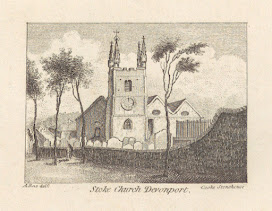
The second entry in Somers Cocks - Cooke, - (lith) - refers to one illustration in Sanford’s editions of The Tourist’s Companion already mentioned. This particular edition appeared in 1828 and 1830[3] and included a small engraving of Stoke Church, Devonport. The signatures are A. Rae delt and Cooke Stonehouse (Fig. 36). Stoke Church is often given special inclusion in his plans and is actually drawn in on some. 


Fig. 36. Stoke Church: From Cooke´s Plan of 1821 (left); and from editions of The Stranger’s Guide (right). 

Between these two engravings Cooke was engaged to produce four plates for William Welch of Stonehouse. Religiosa Philosophia was the presentation of a New Theory of the Earth in unison with the Mosaic account of creation and appeared in 1821 with an Improved Edition in 1822 (Figs. 37 and 38).[4] Printed for the Author by W Byers, Fore Street, Plymouth-Dock the first edition was to be sold by G and W B Whittaker in London but also by local booksellers such as Curtis, Rowes, Bond and May all in Plymouth and Dyer, Cullum, and Besley in Exeter. The second edition was improved with the inclusion of An Essay on Magnetic Influence and the Variation of the Needle (a subject omitted in Cooke´s Synopsis) and sold by Longman and Co., and by Whittaker and Co., London.


Fig. 37. Diagram of a fossil for W Welch´s Religiosa Philosophia, 1821.

In its 133 pages Welch tried to match the fossil findings of the day with the story of the Bible, but rejected the idea of one great flood being responsible. As almost all the fossil reports he had to go on, were of marine life, he was convinced that the Earth had been covered by water at one time and this had receded when God commanded: And God said, Let the waters be gathered together into one place, and let the dry land appear. And it was so, and God called the dry land EARTH, and the gathering together of the waters, called he SEAS. 


Fig. 38. The Firmament for W Welch´s Religiosa Philosophia, 1821. 

Reports of marine fossils date back to very early times, writers such as Xenophanes (570-480 BC), Herodotus (484-425 BC) and Erathostenes (276-194 BC) all believed land had been under water at one time. At about the time that Welch began formulating his theory, Georges Cuvier had consolidated his theories and wrote Recherches sur les ossements fossils de quadrupeds (1812) and lay the foundations of palaeontology, a word which was first coined in 1822 by Henri Marie Ducrotay de Blainville.

One of the four plates Welch engaged John Cooke to execute was an attractive frontispiece – And God made the Firmament .. – with signature Aqua Tint by John Cooke, Stonehouse. This is one of only a handful of known aquatints by Cooke. The slim volume also had two plates of fossils and one further cross-section of 2 mines and the Giant´s Causeway (each plate approx. 200 x 120 mm). There were over 140 subscribers to this work, one being Cook, Mr John, Stonehouse [sic].

In December 1825, a curious single page broadside was published by John Cooke from 48 Union Street. This was a page of text, illustrated with an engraving showing a balloon landing in the sea between Stokehead and Yealm Point, near Plymouth, Devon. George and Margaret Graham, well-known and accomplished balloonists, were no strangers to Devon when they made a tour of the westcountry in 1825. An advertising announcement in the Alfred of August 31st the previous year apologises for failed ascents by Mr Graham in Exeter the previous Tuesday and also in Taunton shortly before and promising to fly his balloon in Exeter on 7th September of that year. One third of receipts were to go to the Royal Devon and Exeter Hospital (Fig. 39).

On their tour of the west country in 1825 they stopped in Plymouth where they attempted a balloon ascent from Stonehouse market in Plymouth on Monday 14th November. A series of pilot balloons released prior to the ascent were all carried out to sea by a strong southerly wind, but nevertheless, the couple set off at 3pm in front of a crowd of 50,000. Sure enough, the balloon was dragged seaward by the wind and came down in the sea only 14 minutes later. After 25 minutes the couple were rescued by a Royal Marine boat and returned to shore. According to some reports, the balloon was lost, last seen rising from the waters and sailing out to France never to be seen again, others write about it being rescued by marines.

The typescript of the broadsheet (Fig. 40) may have been written by the Grahams themselves. Although printed by J Congdon of 28, Fore Street, Devonport, the imprint below the engraving is Cooke´s together with price of 1s and extra line below: with The Description by Mr & Mrs Graham. 


Fig. 39. Announcement in The Alfred, August 21st 1824. 


Fig. 40. George and Margaret Graham´s balloon mishap between Stokehead and Yealm Point, Monday 14th November 1825[5].

Although no more engravings are extant, a number of other maps are known. The Panorama of Plymouth written by Samuel Rowe contained a Map Of The Country Twelve Miles Round Plymouth (29). In October 1824 Cooke’s Chart of Plymouth Sound, and General Guide to Plymouth, Devonport and Stonehouse appeared (31) and Cooke is once again late engraver to the Admiralty. This map bears a dedication: Under the Patronage of the Chamber of Commerce, Plymouth.

When one compares this 1824 map to the Chart ... Taken 1817 one is again struck by the similarities. There are numerous aids to mariners such as copious soundings in every navigable channel, sight lines to aid vessels on their way in, all buoys are clearly marked, and Tor House is not only shown but also has its own vignette (Fig. 41). This would have been clearly visible out to sea and would assist a Captain in their approach.

Perhaps John Cooke’s most republished map was The Environs Of Plymouth Devonport And Stone House (33). The map was actually completed on 4 copper plates but was assembled to form one map and this appeared with the sub-title A Companion to the Different Guides of the Neighbourhood published in Stonehouse by John Cooke circa 1828, it was republished on one sheet and was even reissued by William Wood of Devonport from circa 1850 in various publications including issues of his Three Towns Almanack and his Rambles about Plymouth and Devonport. It even appeared three times in The Three Towns´ Almanack, a popular annual publication (1861, 1865 and 1868).

Cooke attempted to receive patronage for this map in the same way he had obtained it in 1824. In a letter to the Mayor of Plymouth, dated September 1828 Cooke appeals for support:

 To the Chief Magistrate I take the liberty to send you one of my Proposals, at the same time beg to ask the favor of your name, and patronage of the commonalty to be printed on the upper part of it being the wish of several gentlemen of the corporation, in consequence of which I have drawn up the enclosed proposal for your inspection and will be happy of the Honor of your acquesience to the same, as the price of my subscription must be considered moderate, depending on the greater number to pay the expence, will be happy of the Name of any Gentlemen who may honor me in addition to those highly respected Gentlemen who have placed their names on my list.


Signed by Cooke, the handwritten letter accompanied a sheet of proposals for a map that will be engraved on four Plates, to adjoin each other, either to be fitted up as one, or formed into pages for the Pocket or otherwise. It is not clear whether Cooke received the desired effect; the only copy known in four sheets has no dedication but the proposals are Under the Patronage of the Mayor and Commonalty.[6] 


Fig. 41.  Tor House as shown on Cooke´s Chart of Plymouth Sound. 

The Lord Mayor would have been Capt. R Pridham who was Lord Mayor 1827-28. According to the Naval Biographical Dictionary he was a prisoner of war in France for ten years and then on 23 Sept. 1829, in a severe gale off the Cape of Good Hope, his left arm was broken and his wrist dislocated by a fall on the deck at midnight; and he also experienced severe injury in the head.[7] According to the Plymouth Herald of May 1828, Plymouth’s mayor, Richard Pridham summoned an anti-slavery meeting on 23 May 1828, which was ‘more numerously and respectably attended than any public assembly ... witnessed for a considerable time’, with ‘a number of ladies being present’.[8] In 1831 Plymouth had 192 voters of whom only 146 exercised their right to vote in the elections of that year.[9]

Cooke's Stranger's Guide and Pocket Plan of the Three Towns of Plymouth, Devonport and Stonehouse (32) was published in The Traveller’s Directory, and Stranger's Guide to the Three Towns. The map is embellished with coats of arms of the towns and is dated 1827. This work also includes an updated version of the breakwater plan, Cookes Plymouth Breakwater (now at 82, Union Street). Both maps are priced individually, indicating sale as single sheets but the title page of the Directory, however, specifically states that two engravings are included.

The timing of this edition was not arbitrary. We know there was a royal visit to Plymouth and the breakwater: there is a commemorative stone on the breakwater to Prince Wm. Henry, Duke of Clarence, Duchess of Clarence, July 17th 1827. The Traveller’s Directory was published in 1828 and is important for one more reason: on the title page John Cooke refers to himself as Map & Chart Engraver, and Geographer Extraordinary to H.R.H. The Duke of Clarence, Lord High Admiral. 

Subsequent to 1827 only three more works are known: Cooke's New Plan Of The Three Towns (34); a map of Dartmoor (35); and another breakwater plan in 1843 (36). The New Plan is an up-to-date map of the city and is dated 1834; the second map, A Map Of The Whole Of The Dartmoor Forest Devon, although very detailed is undated. The engraver´s signature is extremely pertinent: By John Cooke, Engraver and Geographer Extraordinary to his late Majesty in the 75th year of Age. This testifies to John Cooke´s longevity and reveals that he was still capable of engraving. If born 1765 he would have produced this map in 1840.

Cooke’s last breakwater plan (35) is the most detailed and is interesting for two reasons. Firstly, it is larger than any other plan with, as before, the two plans: the upper plan has title Cooke’s Plymouth Breakwater, and signature; the lower plan, Transverse Section Of The Breakwater. Secondly, it is the bye-line below Cooke’s signature and address that is remarkable - Map & Chart Engraver and Geographer Extraordinary to His late Majesty William IVth – in his 80th year of age.

Why there was a need for a new map of the breakwater in 1843 is uncertain, but it might have something to do with the new lighthouse. This was being built and would, in fact, be officially opened on 1st May, 1844 (it is clearly shown in the plan). To celebrate its formal opening, a postal coach was shipped out and spent the afternoon of July 23rd transporting passengers up and down the breakwater.

So far, we have no evidence that his wife worked and certainly none identifying her as an engraver. What we have are two documents which point to John marrying again. and two causing us some doubt! On the one hand, there is a marriage entry for 4th March 1834 between John Cooke, listed both as sojourner and as widower, and Elizabeth Nile, sojourner of this parish – St Budeaux. The marriage was witnessed by Richard Nile and Ann Williams. The term sojourner is believed to mean they were not local. From the entry in the 1841 census report we know that John Cooke was resident in Union Lane (sic), East Stonehouse and still registered as engraver in that year. His age is given as 70 (but rounding up and down for census reports is known) and his family comprised Eliza Cooke, 50, also an engraver and John (20) and Charles Cooke (12), both chair-makers. The records show that while John junior and Charles were born in Devon, Eliza and John were not. It is tantalizing to think that if Elizabeth/ Eliza was also entered as engraver, could this be the previous Mrs Nile?

Five years after completing his last chart, John Cooke died at the age of 80 of apoplexy on the 11th March, 1845. John’s death was witnessed by a neighbour, Anne Beer, and not by his wife (Fig. 42). In the 1851 census Elizabeth Nile is registered as a widow, resident in Egg Buckland. Although only a few miles apart, St Budeaux and Egg Buckland are not in Stonehouse; the three places form something of a triangle with sides approximately 5 miles long.


Links to sections of I - London


Links to section II - Plymouth. 

Stonehouse (1813-1845) 

Napoleon and Cooke´s first Plymouth engravings 

The Copper-Plate Engraving, and Printing Office (1815-21)

John Cooke of Union Street, Stonehouse (1823-1845)

Summary

Return to Introduction


Link to IV: Short List of John Cooke's works.


Notes to John Cooke of Union Street, Stonehouse (1823-1845)


[1] Somers Cocks: Devon Topographical Prints, 1660-1870; Devon Library Services; 1977. See entries 2157 for Royal Hotel and 1912 and SC. 108 for Stoke Church.
[2] Advertisement in the Cornwall Gazette; Saturday August 23, 1817.
[3] Somers Cocks lists the 1830 edition published by Colman; however, it was also published in 1828 by J Johns in Devonport and Baldwin & Cradock in London.
[4] Devon Archives has a copy of each edition. The BL has the 1821 issue on-line via Google Books but lacks the last page.
[5] Illustration courtesy of Cabinet UK Ltd, official retailers of images in the British Science Museum collection.
[6] My thanks to the West Devon Record Office who made the letter and proposal available – see entry 33.
[7] https://en.wikisource.org/wiki/A_Naval_Biographical_Dictionary/Pridham,_Richard.
[8] See HistoryOfParliamentOnline.
[9] Ibid.

  John Cooke                  Engraver and Publisher: 1765 - 1845                         JOHN COOKE – of London and Plymouth THIRD EDITION ...